
History
Vision Statement and Curriculum Intent
At Stock, we believe History is a powerful way for every child to let their light shine. Our History curriculum provides opportunities for all pupils to explore and understand the events, people, ideas and societies of the past, enabling them to develop curiosity, critical thinking and a lifelong interest in history.
Through high-quality historical learning experiences, children develop an understanding of how the past has shaped the world we live in today. Pupils are encouraged to ask questions, investigate evidence and explore different interpretations of history, helping them to become thoughtful and reflective learners.
We encourage pupils to aspire by nurturing their curiosity and enthusiasm for learning about the past. Children are supported to take pride in their historical understanding, challenge their thinking and develop resilience as they investigate and interpret evidence.
Through engaging and meaningful learning opportunities, pupils are supported to achieve, developing the knowledge, skills and understanding needed to think and work as historians. By celebrating every child’s learning journey, we ensure that all pupils feel valued and empowered to share their ideas and perspectives.
Pupils develop their historical understanding through the study of key events, significant individuals, civilisations and societies from the past. They build chronological awareness, understand how historians investigate the past and learn to interpret and evaluate evidence.
The Stock History curriculum also supports the development of transferable skills, including communication, critical thinking, enquiry, analysis, problem-solving and evaluation. These skills are integral to pupils’ development as learners and have wide application in their lives beyond school.
Core History Skills and Knowledge
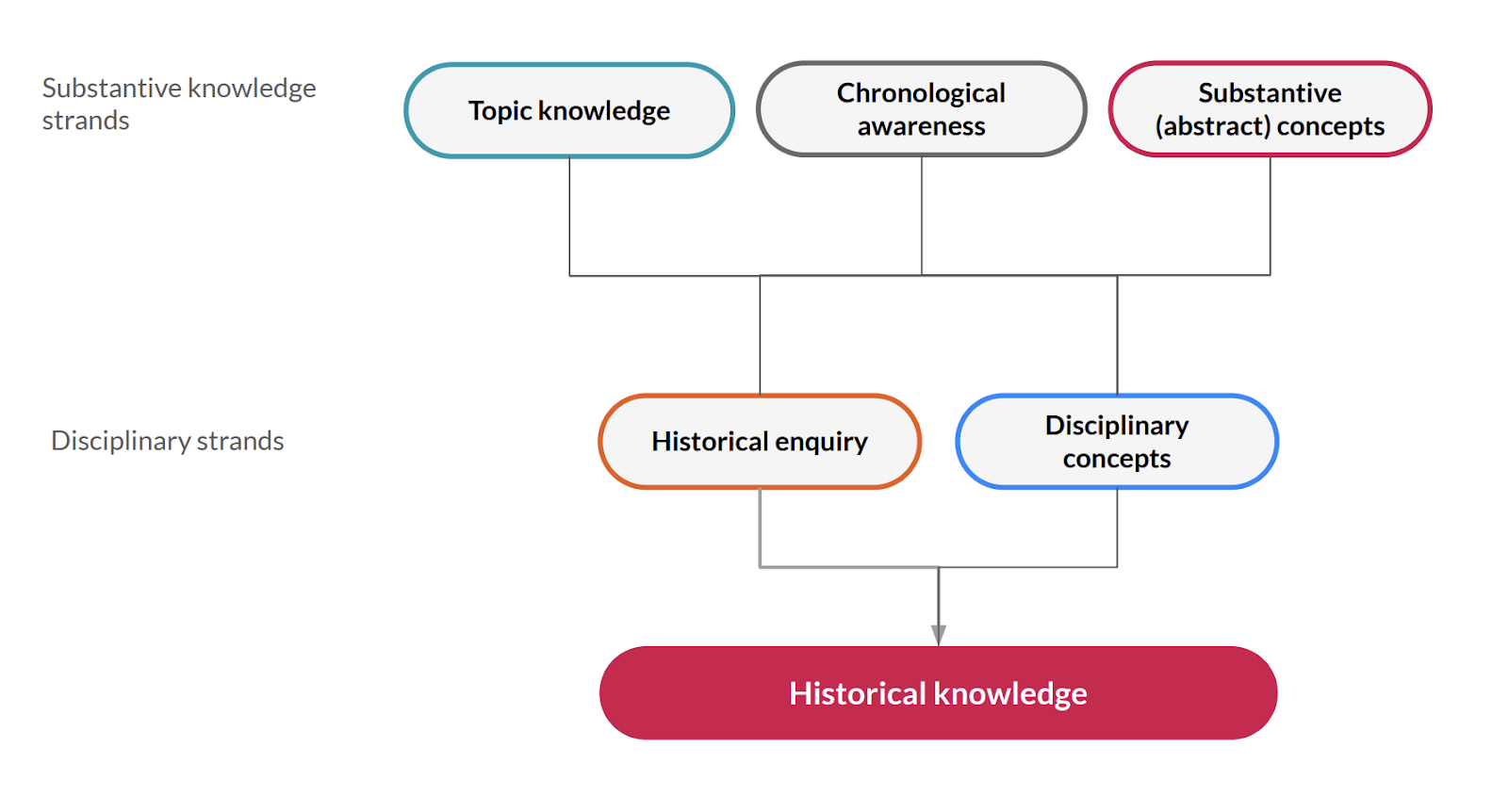
Kapow Primary’s History scheme of work is built around the following five key areas:
- Topic knowledge – investigating key figures or events from historical periods; examining how aspects of life have developed over time.
- Chronological awareness – understanding how historical periods interconnect, overlap and impact each other.
- Substantive concepts – recurring themes, key concepts and fundamental elements of historical knowledge, such as ‘empire’, ‘monarchy’ or ‘invasion and settlement’.
- Disciplinary concepts – learning how historians investigate the past and how they construct historical claims.
- Historical enquiry – experiencing the process that historians use; navigating historical concepts by questioning, investigating, interpreting, evaluating, concluding and communicating.
Substantive Concepts
Exploring and understanding the key events, people, ideas and societies of the past.
Disciplinary Concepts
Understanding how historians find out about and interpret the past.
Historical Enquiry
Posing and answering historical questions using evidence.
Chronological Awareness
Developing an understanding of the passage of time, using language related to chronology and building timelines to place events in chronological order.
Implementation
Each class is taught History through carefully planned units that build knowledge and skills progressively across the school.
Our curriculum follows a spiral curriculum model, ensuring that pupils revisit and develop their understanding of key themes and concepts as they progress. This approach allows them to make meaningful connections, reinforce their learning and achieve mastery over time.
- Revisiting key concepts – pupils encounter the same ideas multiple times throughout their education, with each revisit adding more complexity.
- Progressive depth – concepts are not just repeated but expanded upon, helping pupils to make connections and develop a richer understanding over time.
- Knowledge retention – regular exposure to key ideas strengthens memory and prevents knowledge from being forgotten.
- Skill development – pupils refine and apply their historical skills in different contexts, improving their ability to think critically and analyse evidence.
- Adaptive learning – by building on prior knowledge, the curriculum meets pupils at their current level and supports all learners, including those who need extra reinforcement and those who are ready for greater challenges.
Lesson Structure
Our History lessons follow this typical model:
Recap & Recall
Each lesson begins with a short activity revisiting prior learning. This helps reinforce key knowledge, activate long-term memory and create connections between past and new learning. Recap and recall activities are varied to keep the start of the lesson engaging and enjoyable while supporting active recall.
Attention Grabber
A short, engaging activity designed to hook pupils into the new learning in the lesson. This could be a thought-provoking question, an artefact investigation, a historical source or an interactive discussion to spark curiosity and enthusiasm for the topic.
Main Event
The core part of the lesson, where pupils engage in activities that develop their understanding of the learning objective. This includes a mixture of teacher modelling, guided practice and independent or collaborative tasks tailored to support all learners.
Wrapping Up
A final reflective activity that consolidates learning. This could involve reviewing the success criteria, discussing key learning or applying knowledge in a different context to assess understanding and encourage deeper thinking.
Impact
The impact of our History curriculum is that pupils develop curiosity, confidence and a lasting understanding of the past, enabling them to truly let their light shine. Through rich historical experiences, children build an appreciation of how people, events and societies have shaped the world over time. They are encouraged to aspire as historians, developing resilience, enquiry skills and confidence through investigating and interpreting evidence.
As they progress, pupils achieve by developing secure historical knowledge, chronological understanding and disciplinary skills, enabling them to think critically, ask thoughtful questions and communicate their ideas effectively. Pupils leave with a deeper understanding of the past and the skills needed to become informed and reflective citizens.
Types of Knowledge
The History curriculum enables pupils to develop:
- Substantive knowledge – learning about the events, people, societies and concepts from the past.
- Disciplinary knowledge – understanding how historians investigate, interpret and construct historical claims.
- Chronological knowledge – understanding the sequence of historical events and periods and how they connect over time.
Research Which Underpins Our Curriculum Design
Our History curriculum fulfils the statutory requirements outlined in the National Curriculum (2014) and has been carefully designed to provide pupils with a broad, balanced and ambitious history education. The curriculum is informed by research into effective teaching and learning, ensuring that pupils build secure knowledge over time while developing the disciplinary skills needed to think and work as historians.